The $200 Water Sample: Why That Trip to the Pool Store Is Quietly Draining Your Wallet
The in-store water test that's supposed to fix your pool is often what keeps it broken. Here's why your sample is inaccurate before it's even tested — and what actually works instead.
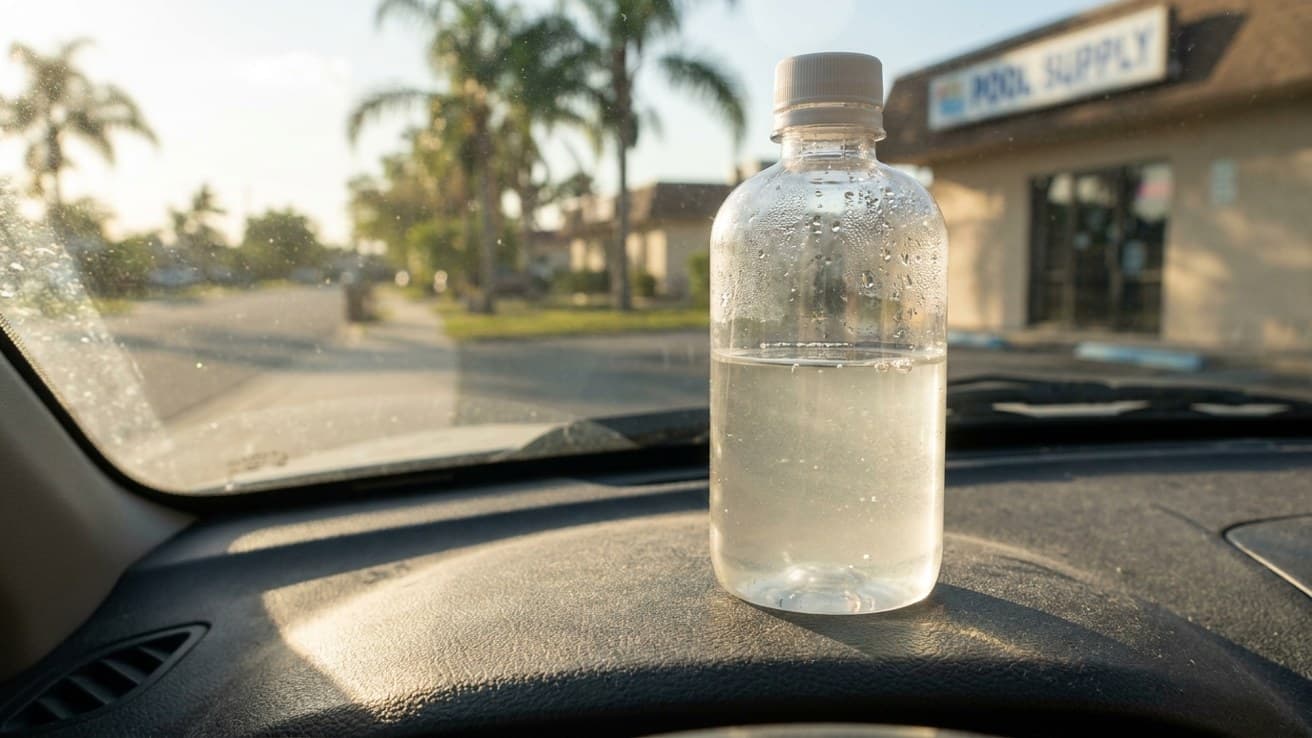
You know the ritual. You scoop a cupful of pool water into an old Gatorade bottle, drive it across town, and hand it to the teenager behind the counter at the pool supply store. A minute later, a printout slides across the desk with a list of numbers and a shopping cart's worth of jugs and bags you “need.” You buy them. You pour them in. And two weeks later — you're back, bottle in hand, doing it all over again.
If that cycle feels endless, it's not your imagination. Here at Ducky's Pool Care, we see the aftermath every week: homeowners who did everything the printout told them to and still have cloudy, green, or itchy water. The uncomfortable truth is that the in-store water test — the thing that's supposed to fix your pool — is often what keeps it broken. Here's why.
1. Your sample changes the moment it leaves the pool
Pool water chemistry is alive and moving, and the single most important number — free chlorine — starts disappearing the instant you dip that bottle. Sunlight is the culprit. Ultraviolet rays break chlorine down through a process called photolysis, and it happens fast: the sun can destroy up to 90% of unstabilized chlorine in about two hours. A clear bottle riding shotgun in your sunny car is basically a chlorine-destruction chamber.
This is exactly why the pros who make the testing equipment tell you, in bold letters, to analyze samples without delay. Samples should be tested fresh — ideally within about 30 minutes — and kept away from light. By the time your sample has sat on a shelf waiting its turn behind six other customers, the number on that printout may describe a pool that no longer exists.
2. The same water gets different answers at different stores
If the test were truly reliable, you'd get the same reading everywhere. You don't. Homeowners have documented the same pool-water sample producing widely different results at four different stores on the same day.
There are real reasons for this. In-store testing machines require regular calibration and maintenance, and they drift out of accuracy when that upkeep slips. The chemical reagents used to run the tests degrade over time, and a busy store burns through far more reagent than any homeowner — meaning bottles can be old, contaminated, or past their prime. Even a genuinely well-run store is only as good as its last calibration and its freshest reagent.
3. High chlorine can read as zero — and send you the wrong way
Here's a trap that fools even the printout. Standard DPD color tests have a critical flaw: if your free chlorine is above roughly 10 ppm, the test bleaches out and reads clear — a false “low” or even zero. The CDC warns about this exact failure directly.
Imagine the whiplash: your pool is actually over-chlorinated, but the test says you have none. So you're told to add more. Now you're dumping sanitizer into water that already had too much — the opposite of what it needed.
4. The stabilizer trap that keeps you buying chlorine forever
This is the big one, and it's the cycle that costs homeowners the most money over a season.
Cyanuric acid (CYA) — the “stabilizer” or “conditioner” in most tablets and granular shock — protects chlorine from the sun. A little is essential. But too much CYA locks up your chlorine, leaving it present on a test but unable to actually sanitize. Your water reads “fine” on free chlorine yet still turns green, so the advice is to add more chlorine. If you're using stabilized tablets to do it, every dose adds even more CYA, tightening the trap.
A pool-store test that doesn't properly measure CYA — or worse, doesn't understand it — can't warn you this is happening. It just keeps selling you the very product making it worse.
The cycle, laid bare
1. You take a sample that's already degrading before it's tested.
2. The store's machine (drifted, or running old reagent) gives a reading that may not match reality — or another store.
3. You buy and add chemicals based on that reading.
4. You over- or under-correct, throwing a different number out of balance.
5. The water still looks off, so you go back — and the cycle starts again.
Each lap costs you gas, time, and a bag or jug of something you may not have needed. Over a Florida swim season, that adds up to real money spent chasing a moving target.
What actually works
The fix isn't more trips — it's better testing and a real strategy:
- **Test at the pool, in real time** — free chlorine and pH should be measured where the water lives, not after a car ride. A quality DPD drop kit (like a Taylor kit) used poolside beats a stale sample every time
- **Know your CYA** — balancing a pool without knowing its stabilizer level is guessing; it changes how much chlorine you actually need
- **Correct one thing at a time, then retest** — after the pump has circulated and the chemical has fully dispersed (roughly 30+ minutes), not five minutes later
- **Stop chasing, start managing** — a consistent testing rhythm and the right dosing turns your pool from a money pit into a set-it-and-forget-it amenity
Bottom line
That's the whole reason Ducky's Pool Care exists. We test your water at your pool, read it correctly the first time, and treat the actual problem — not the one a bleached-out test strip invented. No more Gatorade bottles. No more surprise shopping carts. No more green pool the week after you “fixed” it.
Stop driving your water across town. Let us bring the expertise to your backyard — message Ducky's Pool Care to schedule service and get off the pool-store treadmill for good.