
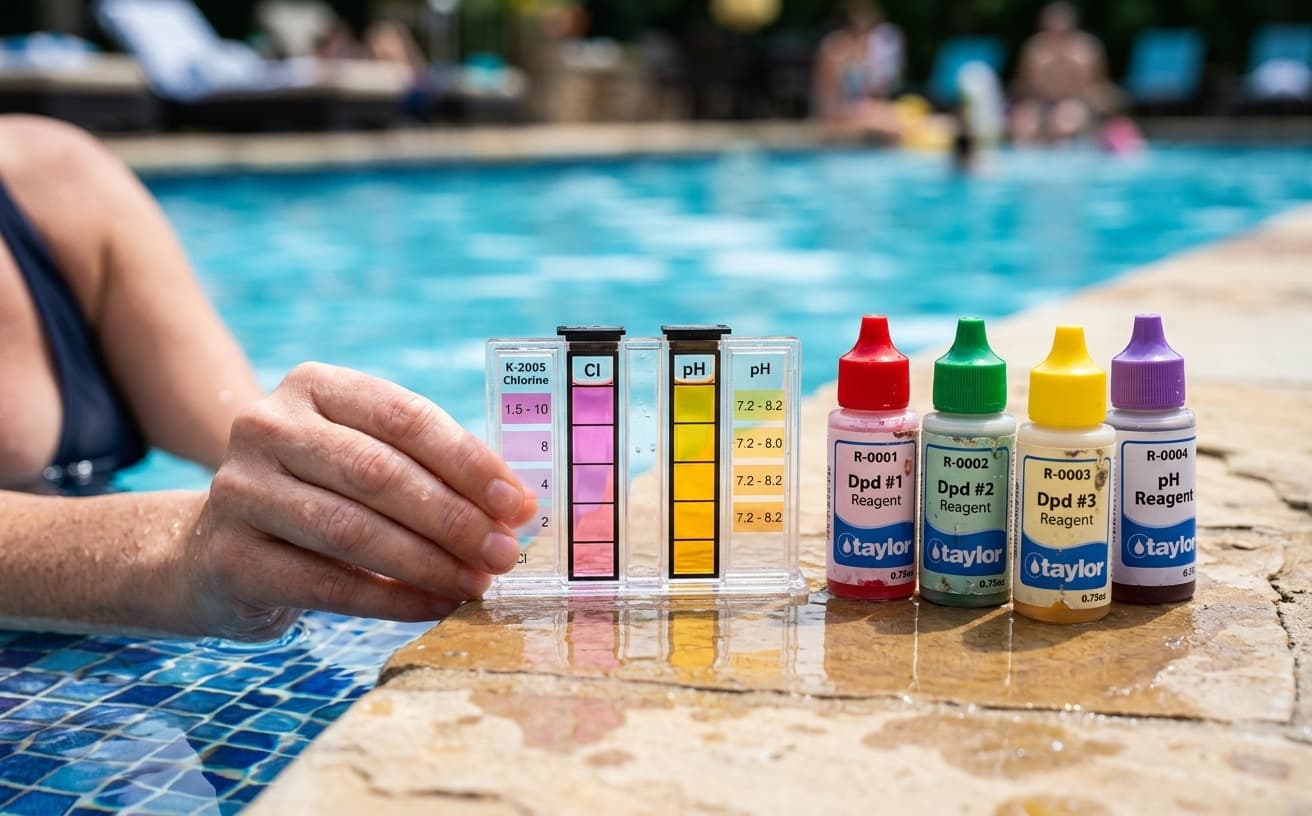
Florida pool maintenance, explained by the people who actually do it.
Weekly pool care you can count on. Get your free estimate in under 30 seconds.
Eight things that should happen every single week.
Skip any one of these in Central Florida and water chemistry will quietly drift. Miss two and you'll see it.
Leaves, pollen, and bugs — remove before they sink.
Clogged baskets destroy pump efficiency and strain motors.
Disrupts biofilm before it becomes algae.
Chlorine, pH, alkalinity, CYA, salt (if applicable).
Dose to target, not by eyeball.
When pressure is 8–10 PSI above clean baseline.
8–10 hours/day summer, 6–8 hours winter for most residential pools.
Spot-vacuum debris or run the robot.
Hit these numbers. Everything else gets easier.
These are the ranges every CPO-certified technician works to. Drop-count or photometric tests only — test strips are for emergencies.
| Parameter | Target range | Why it matters |
|---|---|---|
| Free Chlorine (FC) | 1–3 ppm | Kills bacteria and algae. Drops fast in Florida sun. |
| pH | 7.4 – 7.6 | Too high = scale + dull chlorine. Too low = corrosion. |
| Total Alkalinity (TA) | 80 – 120 ppm | Stabilizes pH against spikes. |
| Calcium Hardness (CH) | 200 – 400 ppm | Prevents etching (low) and scaling (high). |
| Cyanuric Acid (CYA) | 30 – 50 ppm | Stabilizer. Protects chlorine from UV. Too much = chlorine lock. |
| Salt (SWG pools) | 2,700 – 3,400 ppm | Generator-dependent. Check cell output separately. |
Central Florida pools don't close. They adapt.
The tasks that matter shift with the seasons. Here's what to focus on, and when.
Spring (Feb–May)
- Pollen blooms — expect to skim daily or run the pump longer
- Check stabilizer (CYA) before summer UV arrives
- Schedule a deep tile clean and equipment tune-up
- Watch for metal staining from well-water top-offs
Summer (Jun–Sep)
- Run the pump 8–10 hours daily, sometimes more
- Shock after heavy rain, heavy bather load, or cloudy days
- Watch phosphate levels — high phosphates feed algae
- Inspect salt cell output weekly; heat cuts efficiency slightly
Fall (Oct–Nov)
- Leaf storms from live oaks — get a leaf trap for the skimmer
- Brush more frequently as water temps drop
- Inspect heater before winter cold fronts
- Reduce pump runtime slightly as UV drops
Winter (Dec–Jan)
- Still test weekly — warm days cause quick chlorine burn
- Protect exposed plumbing with insulation during cold snaps
- Run pump during freeze warnings (24 hrs if below 32°F)
- Don't 'close' the pool — Florida pools aren't closed, they're dialed down
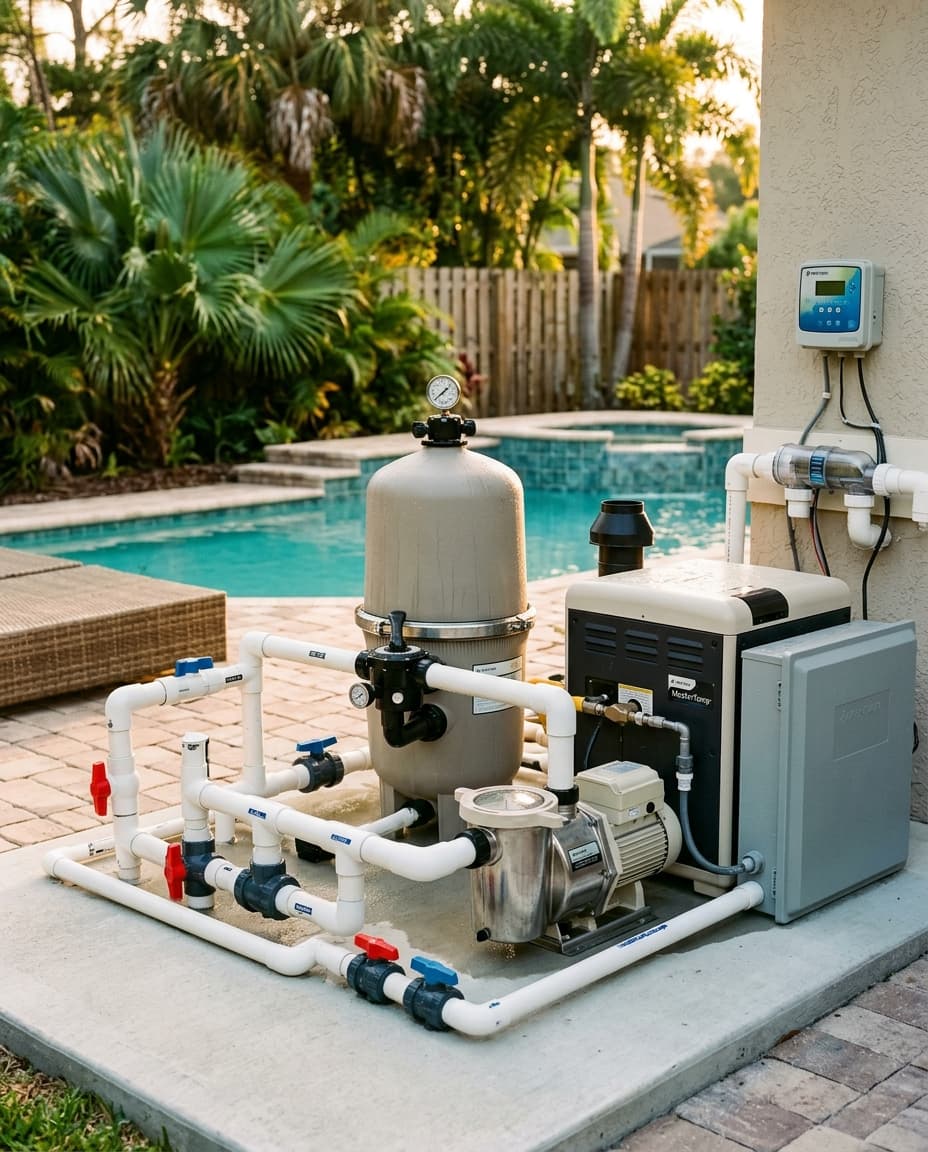
Your equipment is a system. Treat it like one.
Most equipment failures are preventable with quarterly attention. Here's what every homeowner should know.
- Pump seals dry-rot if the pump sits idle — run it even in winter
- Filter pressure above +10 PSI means it's time for a backwash or cartridge rinse
- Salt cells need inspection every 3 months; clean with mild acid only when needed
- Heaters need annual gas-pressure and ignition checks before winter use
- Automation controllers (Pentair, Jandy, Hayward) need firmware updates occasionally
- LED lights should be tested monthly — failed lights often indicate wiring concerns
The 8 most common Florida pool-care mistakes
We see these on almost every neglected-pool first visit. Avoiding them alone puts you ahead of 80% of DIY owners.
- 1Trusting test strips over drop-count testing
- 2Only shocking when water looks bad (too late)
- 3Letting CYA creep above 80 and wondering why chlorine won't hold
- 4Skipping filter pressure checks until the pump struggles
- 5Adding chemicals without waiting between doses
- 6Ignoring phosphates (algae loves them)
- 7Running the pump too few hours in summer
- 8Brushing only when it looks dirty (biofilm is invisible)
Or — let us handle it.
If the above feels like a second job, it's because it is. Get a custom quote in under 30 seconds.
Pool maintenance FAQ
How much does pool maintenance cost per month in Orlando?+
Is it worth paying for professional pool maintenance?+
How often should a pool be serviced in Florida?+
What's the hardest part of Florida pool maintenance?+
Can I maintain my pool myself?+

Tired of chasing chemistry? We'll take over.
Weekly pool care you can count on. Get your free estimate in under 30 seconds.